 By Admin
 Table of Contents
- The Global Hunt for Premium Yarn
- Defining “Premium”: Key Metrics for Sourcing Excellence
- Sourcing Hub I: China – The Engine of Scale and Specialization
- Sourcing Hub II: South & Southeast Asia – Cost & Supply Chain Agility
- Sourcing Hub III: Europe & Advanced Markets – Niche & Luxury
- Beyond Geography: Online Platforms and Modern Sourcing Channels
- Evaluating Suppliers: A Practical Audit Framework
- Navigating Logistics, Cost, and Compliance
- Future Trends: Smart Sourcing for 2026 and Beyond
- FAQ
1. The Global Hunt for Premium Yarn
For industrial buyers—from apparel manufacturers to carpet producers and toy makers—the quest for premium yarn is a strategic endeavor that directly impacts product quality, brand reputation, and profitability. The term “premium” transcends price; Where to Source Premium Yarn: A Global Guide for Industrial Buyers it signifies yarn with exceptional consistency, advanced functionality, sustainable pedigree, or rare material composition. However, the global supply chain is complex and fragmented. While China remains a dominant force with deep specialization, new hubs in Vietnam and Bangladesh are rising, and European suppliers lead in luxury fibers. This guide provides a data-driven, strategic framework to navigate this landscape. We will dissect key sourcing regions, decode quality parameters beyond marketing claims, and outline practical steps to identify and partner with factories that deliver genuine, reliable quality. Your goal is not just to find a supplier, but to build a resilient, value-adding supply chain.
2. Defining “Premium”: Key Metrics for Sourcing Excellence
Before exploring where to buy, you must define what to buy. “Premium” is validated by concrete, measurable data. Request and verify these certificates and test reports from any prospective supplier:
- Quality & Consistency Benchmarks:
- Uster Statistics: The global language of yarn evenness. Premium yarns should provide Uster test reports showing low CVm (Coefficient of Mass Variation) and minimal imperfections (thick places, thin places, neps). Top-tier mills often achieve results in the 5%-25% range of the Uster Statistics communiqué.
- Physical Test Reports: Critical parameters include tenacity/strength (cN/tex), elongation, hairiness, and twist uniformity. For example, a supplier of industrial TC65/35 yarn may boast a tensile strength of ≥18 cN/tex and a strength CV value below 3.5%.
- Technical & Process Certifications:
- ISO 9001: The baseline for a documented quality management system.
- Specialized Process Certificates: Such as Oeko-Tex Standard 100 for harmful substance control, GRS (Global Recycled Standard) for recycled content, or SUPIMA license for authentic extra-long staple cotton use.
- Supplier Operational Capabilities:
- Minimum Order Quantity (MOQ): Ranges from tons for commodity yarns to as low as 5-10 kg for true custom premium lines.
- Lead Time & Flexibility: Standard production may take 30-45 days, but leading suppliers offer rapid sampling in 7-10 days and “fast-track” production lines.
3. Sourcing Hub I: China – The Engine of Scale and Specialization
China is not a monolithic source; it’s a continent of specialized clusters. Sourcing success depends on matching your need with the right region.
Table 1: Premium Yarn Specialization Clusters in China
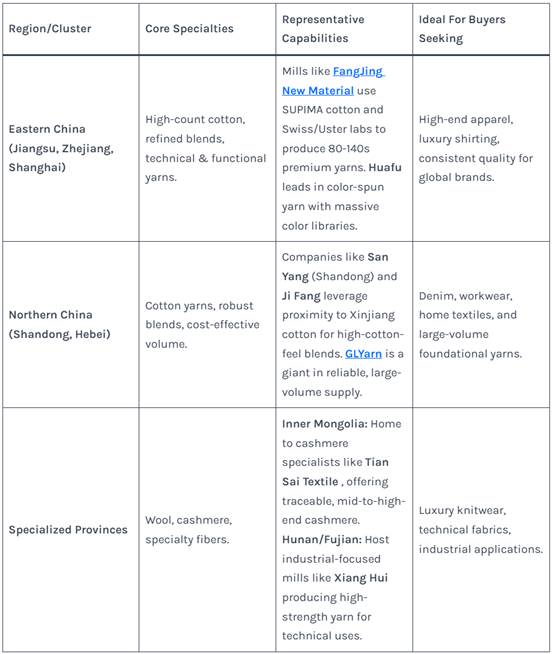
Key Advantage: Unmatched vertical integration, from fiber to finished yarn, ensuring cost and quality control. Key Challenge: Requires diligent vetting to distinguish true premium producers from mass-market factories.
4. Sourcing Hub II: South & Southeast Asia – Cost & Supply Chain Agility
This region has evolved from a low-cost alternative to a strategic hub for agility and specific advantages.
- Vietnam: A primary sourcing destination for cotton yarn. It offers competitive pricing, duty advantages to key markets (EU, CPTPP), and growing quality. It is a top supplier to China itself.
- Pakistan & India: Traditionally strong in cotton yarns. Pakistan is known for certain carded counts, while India has strengths in organic and sustainable cotton. Their position is being challenged by Southeast Asia on cost.
- Bangladesh & Malaysia: Emerging players. Bangladesh, leveraging its garment industry’s growth, is increasing its yarn import share. Malaysia holds a stable niche.
- Strategic Value: Ideal for diversifying supply chains, accessing trade agreement benefits, and sourcing volume-driven, cost-sensitive premium yarns where ultimate luxury is not the primary goal.
5. Sourcing Hub III: Europe & Advanced Markets – Niche & Luxury
For the pinnacle of luxury, innovation, and sustainability storytelling, look to these regions.
- Italy, Portugal, UK: The home of luxury cashmere, merino wool, and bespoke fancy yarns. Brands like Loro Piana set the global standard for ultra-fine fibers. Mills here excel in micro-lot customization, heritage craftsmanship, and serving top luxury houses.
- Turkey: A powerful bridge between East and West, specializing in high-quality cotton yarns, organic cotton, and sophisticated blends. Excellent for buyers wanting European-adjacent quality with shorter lead times than East Asia.
- United States: Focus on high-end cotton (like SUPIMA) and technical/performance yarns. Strong on sustainability certifications and brand-safe supply chains.
- Strategic Value: Non-negotiable for true luxury brands, cutting-edge technical textiles (e.g., for automotive, medical), and projects where sustainability credentials and traceability are central to the brand.
6. Beyond Geography: Online Platforms and Modern Sourcing Channels
Geography is no longer destiny. Digital tools have revolutionized discovery and transactional efficiency.
- B2B Online Marketplaces: Platforms like China’s “You Sha” aggregate thousands of mills, allowing buyers to search by specification, compare prices, and manage orders digitally. These are excellent for discovery, spot purchases, and benchmarking.
- Regional Sourcing Platforms & Trade Shows: Initiatives like “Keqiao Preferred” in China’s fabric heartland curate and certify high-quality local suppliers, connecting them directly with brands. Attending major trade shows (ShanghaiTex, ITMA, Pitti Filati) remains irreplaceable for seeing, touching, and building relationships.
- Hybrid Strategy: Use online platforms for initial research and efficiency, but always validate with physical samples, factory audits, and relationship building. The most successful buyers use digital tools to manage, not replace, human-led quality assurance.
7. Evaluating Suppliers: A Practical Audit Framework
Finding a factory is easy; vetting a premium partner is critical. Move beyond brochures with this checklist:
- Technical Audit:
- Request Uster and physical test reports for the exact yarn you intend to buy, not a “representative” report.
- Ask for certification copies (ISO, Oeko-Tex, etc.) and verify their validity online.
- Inquire about core equipment. Premium mills invest in machinery from Germany (Trützschler, Zinser), Switzerland (Rieter), Japan (Murata), and use Uster monitoring systems.
- Capability & Transparency Audit:
- What is the true MOQ for a custom color or blend?
- Can they provide full traceability? For example, can a cashmere supplier trace batches back to specific herds or regions?.
- What is their R&D process? Do they have a dedicated team and partnerships with institutions?.
- Commercial & Cultural Fit:
- Discuss payment terms. Flexible but secure terms (e.g., TT with portion against BL copy) are a sign of a confident partner.
- Assess communication. Are they responsive, technically fluent, and proactive?
- Request and contact references from clients in your region or sector.
8. Navigating Logistics, Cost, and Compliance
- Total Landed Cost Analysis: The FOB price is just the start. Calculate + Shipping & Logistics + Import Duties + Insurance + Potential Quality Inspection Costs. A slightly higher FOB price from a geographically closer or more reliable supplier often results in a lower total cost and less risk.
- Logistics Strategy: For large volumes, container-direct shipping is standard. For smaller, premium lots, consider consolidation services or suppliers who offer overseas warehouse stocking, a service some advanced Chinese suppliers now provide for Southeast Asian markets.
- Compliance is Paramount: Ensure your yarn complies with the reach regulations of your market (EU, USA, etc.). The supplier’s Oeko-Tex Standard 100 certification is a strong starting point but confirm it covers your product class (e.g., Class I for babywear).
9. Future Trends: Smart Sourcing for 2026 and Beyond
- Sustainability as a Baseline: Premium is increasingly defined by verified sustainable practices—use of recycled (GRS-certified), organic, or bio-based fibers, along with water/energy reduction metrics.
- Digital Traceability: Blockchain and IoT will move from buzzwords to necessities, allowing you to track the journey of your specific yarn lot from farm to factory.
- AI-Powered Matching: B2B platforms will evolve beyond search to AI-driven recommendations that match your technical specs, past preferences, and sustainability scorecard with ideal suppliers.
- Nearshoring for Resilience: While global hubs remain vital, expect growth in strategic nearshoring—sourcing from regions like Turkey for Europe or Mexico for the USA—to mitigate geopolitical and logistical risks.
10. FAQ
Q1: Is it better to source directly from a factory or through a trading company?
A: For premium, technical, or large-volume yarns, direct factory sourcing is almost always better. It ensures better price control, technical communication, and quality oversight. Use a reputable trading company for smaller, mixed orders, spot purchases, or when navigating a new, complex region where they handle logistics and quality consolidation.
Q2: What are realistic payment terms for a first order with a new premium supplier?
A: Expect 30% deposit, 70% against copy of Bill of Lading (BL) for a first order. As trust builds, you can negotiate to 100% payment against BL copy or even open account terms. Be wary of suppliers demanding 100% upfront.
Q3: How can I effectively verify a supplier’s claims about using special raw materials like Xinjiang cotton or Mongolian cashmere?
A: Demand transaction certificates and traceability documentation. For Xinjiang cotton, this could be a transaction certificate from the China Cotton Association (CCA). For cashmere, suppliers like those in Inner Mongolia should provide batch-specific test reports showing fiber diameter and length, and some can trace back to shearing batches. Third-party verification is key.
Q4: We are a small designer brand with low volume but need high-quality, custom yarn. Are there suppliers for us?
A: Yes. Look for suppliers that explicitly advertise “small-batch customization” or “low MOQ.” Many premium mills, especially in China and Europe, now cater to this market. Examples include suppliers offering 5kg or 10kg MOQs for custom development. Be prepared to pay a premium per kilogram for this service.
Q5: What is the single most important document to request when evaluating a premium yarn supplier?
A: The most revealing document is a recent Uster test report for a production batch of a yarn similar to your target. This data-heavy report objectively reveals the yarn’s evenness, imperfections, and overall quality level, cutting through marketing claims.